
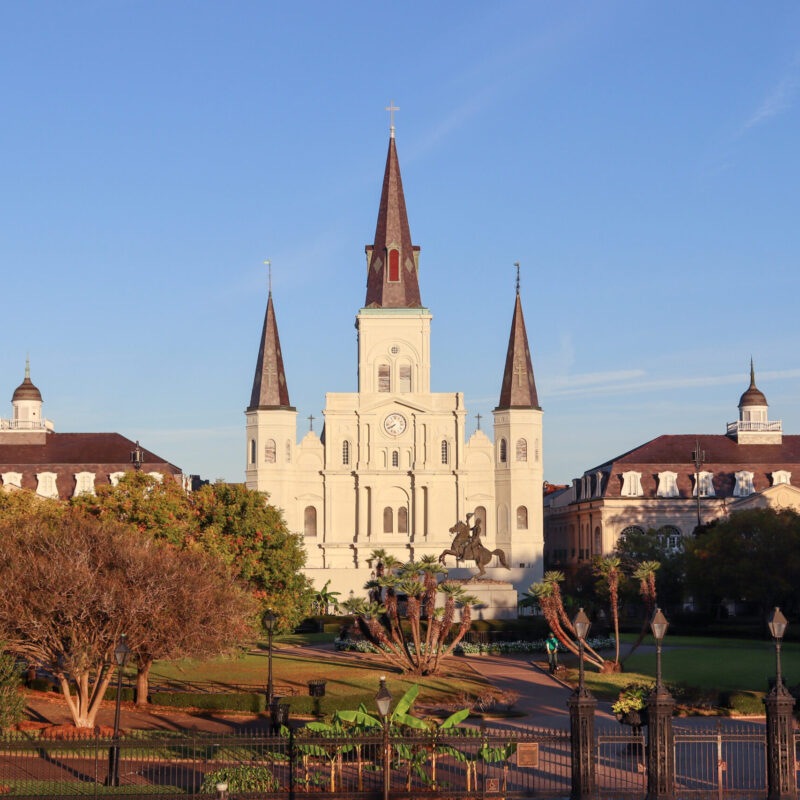
A $45 million restoration will transform the St. Louis Cathedral: ‘A beacon in our city’
Kevin Morris knows St. Louis Cathedral like few other people.
Carefully ascending its creaky wooden stairs, climbing through tight doorways and navigating narrow catwalks as if by rote, Morris points out termite damage here, water damage there, and numerous signs of decay at points in between.
Morris, president of Holly & Smith Architects and the chief architect of an ambitious and expensive cathedral restoration project that will begin this summer and likely last the rest of this decade, has spent countless hours poring over old drawings and peering into the building’s many dark corners.
He knows the place like a doctor might know a longtime patient — and he knows that the grandeur of St. Louis Cathedral that people see from the outside doesn’t always match what is revealed on the inside.
“People are blown away by the beauty of it, the historic aspect of it, its significance,” he said. “But I don’t think that the general public knows how much deterioration is going on.”
The cathedral has withstood disasters, war, pandemics and even a bomb blast. Churches on the Jackson Square site in New Orleans’s French Quarter have been destroyed and rebuilt over a three-century history. The current structure, which dates to 1851, is easily the most famous landmark in one of the world’s most famous neighborhoods. And it’s showing its age.
The Archdiocese of New Orleans is expected to soon announce details of the extensive work that will cost an estimated $45 million, all paid through donations being raised in a private campaign called “Our City Our Cathedral,” spearheaded by New Orleans Saints and Pelicans owner Gayle Benson.
Specific timetables and other details will come, but in a few months, scaffolding will arise and encase the cathedral as work begins. The exterior overhaul will come first, and could last at least two years; work will then move to the interior for another 18-24 months. (Scaffolding covered in plywood is already in place across the front of the cathedral, to protect patrons from stucco that has been falling from the façade.)
The restoration comes as the archdiocese emerges from a grueling, yearslong bankruptcy, and as a new archbishop, James Checchio, takes the reins from the now-retired Archbishop Gregory Aymond.
“Our cathedral restoration project is about much more than preserving a historic building,” Checchio said in a prepared statement. “It is also about preserving the legacy of faith in our city — a legacy with 300-year-old roots in the cathedral. … This restoration renews that legacy of faith, ensuring St. Louis Cathedral stands as a beacon in our city for generations to come.”
Benson is a longtime cathedral parishioner for whom the cathedral holds a special place — she met her husband, the late Tom Benson, while doing volunteer work there in the 2000s.
She says the importance of restoring and preserving the building cannot be overstated.
“The presence you feel there — St. Louis Cathedral is more than a church,” she said one recent evening from Paris, just hours after she had toured Notre-Dame de Paris cathedral with Philippe Villeneuve, the architect who led its massive restoration after a devastating 2019 fire.
In March, Benson attended a discussion at the New Orleans Book Festival at Tulane University about the Notre Dame and St. Louis Cathedral restorations. Toward the end of the discussion, Morris, who was on the stage with Villeneuve, flashed a slide that showed the view from Jackson Square of the Cabildo and the Presbytère — but with a parking lot between them where the cathedral now sits.
There were gasps from the audience as they pondered the absence.
“So powerful,” Benson said.
“It is THE iconic image of New Orleans,” said Ann Masson, a New Orleans resident and architecture historian who has written extensively about St. Louis Cathedral.
Masson recalled the harrowing time in the city following Hurricane Katrina. “We didn’t even have lights, but when (President) George Bush came to the city, where was he standing?” she asked. “He was in front of the cathedral.”
‘This is a huge job’
As the exterior work takes place, the cathedral will remain open for Mass, weddings and other events until the summer of 2027. Work will then move inside. The cathedral has stopped booking weddings after July 2027, officials say. The Rev. Patrick Williams, the cathedral rector, said the desire is to keep the cathedral open for Mass as long as possible, but said as the interior work progresses, that might not be possible.
“We’re also trying to minimize how it will impact our neighbors,” Williams said. “Given the geography, it’s going to be a challenge.”
Once the scaffolding goes up, workers and specialists will remove and replace deteriorated stucco and repair the masonry beneath it. The scaffolding along the front façade will be shrouded in fabric with the image of the cathedral on it.
New slate and underlayments will be installed on the upper and lower gable roofs, Morris said. Termite-damaged sections of the roof framing will also be repaired.
A roof enclosure on a set of rails will be erected that can slide over exposed areas to protect the building from south Louisiana’s notoriously rainy summers or during periods when tropical weather threatens, Morris said.
Inside, the stained-glass windows depict the life of Louis IX, the 13th-century king of France who was canonized in 1297 and was the original church’s namesake. Those will be repaired and restored, Morris said. The deteriorating plaster ceilings, nearly 150 years old, will be removed and reconstructed, along with the murals and iconography on them.
Walls and floors will be repaired and refinished. A new fire-protection sprinkler system will also be installed.
“The interior has probably not been touched since 1975,” Morris said.
As the ceiling is removed, artist Erasme Humbrecht’s circa-1870s scenes depicting the life of Jesus will require delicate care. The paintings are on canvas, affixed to the plaster. A New Berlin, Wisconsin, company, Conrad Schmitt Studios, will handle the restoration work for the paintings and stained glass.
“This is a huge job,” Morris said, noting the extensive prep work required to find the right experts and craftspeople.
Morris, 55, feels a calling to the job. A devout Catholic, the Brother Martin High School and LSU graduate said there’s a “spiritual connection” he feels to this project. His high school years are full of memories of events and Mass at the cathedral. And his home is filled with photos collected by his wife, many of which depict the cathedral.
“Every day I walk out of my house and I see those photos,” he said. “For me, it’s sort of a ‘God winks’ moment.”
Holly & Smith, with a New Orleans office on Magazine Street, is overseeing the project and has been working closely with the contractor chosen for the job, Ryan Gootee General Contractors of New Orleans, to vet numerous subcontractors.
Many of the project’s details remain fluid, Morris said, and will be decided by review committees. He and others have worked closely with the state Division of Historic Preservation and the Vieux Carre Commission, which is charged with protecting the French Quarter and its buildings.
It’s a complicated organizational effort with numerous moving parts. Problems are bound to be discovered along the way, Morris said.
“We’ve had bigger projects, but this is the biggest historical project we’ve ever worked on,” he said of his company.
While the cathedral restoration is pegged at $45 million, the fundraising campaign’s goal is $75 million. Of the additional money, $10 million would be earmarked to renovate and repurpose the rectory, and $20 million would fund two endowments to cover operating expenses, as well as long-term maintenance.
Campaign organizers declined to get into details, but Benson said the drive has been very successful and she is confident the goal will be met.
From ‘garish’ to icon
St. Louis Cathedral, which carries the formal title “Cathedral-Basilica of St. Louis, King of France,” is a focal point of the Roman Catholic Church in New Orleans.
The building that is so recognizable now — the popular backdrop to untold thousands of photos and television shots — is actually the latest of a series of church buildings on the site.
Pope Paul VI designated it a cathedral basilica in 1964, but the more formal title never seemed to catch on with the populace.
Its history is marked by triumph and tragedy.
Some histories mention an “early church” at the location around 1722 that was destroyed by a hurricane. A permanent church opened at the site in 1727. That church went up in flames during the Good Friday fire that consumed much of New Orleans in 1788.
A new church was completed and consecrated in 1794. But population growth spurred an ambitious renovation in the 1840s that, complicated by construction mishaps, resulted in the church being substantially rebuilt. The new church was completed in 1851 and is largely the design of Jacques Nicholas de Pouilly, one of the city’s most successful architects, Masson said.
In a 2024 article for the Preservation Resource Center of New Orleans, Masson wrote that de Pouilly’s “French Romantic” design brought in elements of several different architectural styles, including Greek Revival and Gothic Revival. De Pouilly was “quite avant-garde in his moment,” Masson said in an interview. “What we’re looking at is a very modern building from the 1850s.”
Some critics at the time called it “garish” and “showy,” Masson’s research found.
The subsequent years would see very little in the way of change to the cathedral as the city grew up around it. Among the eras and events the cathedral has survived, there was a bomb blast on a quiet Sunday afternoon in 1909 that left the city stunned.
While no one was hurt, newspaper accounts from the time said the blast knocked out many of the windows and caused extensive damage to the organ and choir loft. No cause or attack was ever identified, but theories abounded. The police at the time insisted it was a deliberate act, but the state’s fire marshal suggested that dust from construction work could have caused the blast.
New Orleanians rallied to raise the $5,000 needed to repair the damage.
The cathedral isn’t sinking
As he showed a group around the cathedral one recent morning and pointed out signs of its deterioration, Morris said it’s important to fortify the structure, but preserve its identity and appearance.
Morris and the others involved in the project have studied the cathedral for the past few years in preparation for this summer’s start. The prep work has been both high- and low-tech. Workers strapped with computer-camera equipment walked the interior to create sophisticated Lidar images, while outside, workers used a doorknob-like ball on the end of a stick to perform “soundings” of the stucco walls to determine where it was pulling free from the masonry.
One thing the research has concluded: St. Louis Cathedral is not sinking.
Such a tragedy had been feared and reported by media outlets over the years. But Morris said extensive testing of the layers of soil beneath the cathedral’s foundation revealed the building is stable.
Morris said a section of the floor was removed and a team led by University of New Orleans anthropologist Ryan Gray probed the ground beneath it. They found soot from the 1788 fire — “He said it still smelled like fire,’’ Morris said — but no hard evidence that the building is sinking.
“Without some massive geological event, the cathedral is going to stay where it is,” he said.
Notre Dame as inspiration
Morris was part of a delegation that Benson put together to visit Paris in 2023 to closely view the rebuilding of Notre Dame.
That trip, Benson and Morris both agree, gave those involved an up-close look at what worked and what didn’t, and some inspiration, too.
During the panel discussion at Tulane for the book fest, Villeneuve said Notre Dame was “very ill,” even before the devastating fire, facing years of backlogged maintenance and the absence of any substantial work since 1937.
Prior to the fire, Villeneuve and others had done the needed work in a piecemeal fashion, catching it as money and time permitted. The cathedral’s near destruction in an April 2019 fire prompted an outpouring of grief the world over.
But buoyed by national pride and a large budget — upward of $800 million, covered by donations and some government funding — a legion of workers descended on Paris to rebuild that national treasure.
“I was like a bulldog,” Villeneuve told the book festival audience, noting the focus he developed as head of the effort.
“If you don’t go in my direction, I kill you,” he joked, and the audience laughed.
There will be bumps’
While comparing the restorations of Notre Dame and St. Louis Cathedral can very much be an exercise in apples and oranges, there are some similarities.
One will be the logistical hurdles.
Working in the French Quarter’s vibrant streets of visiting tourists will be challenging, as will the comings and goings (and parking, lodging, feeding) of teams of workers. Disruptions to life in the Quarter are expected, and those details, like many others, remain a bit in the air.
Morris said part of St. Anthony’s Garden, which sits behind the cathedral, would become a staging area for the scaffolding contractors.
Meanwhile, life and worship at the church will go on amid the work. The cathedral has weekday Mass at 12:05 p.m. Saturday Mass is at 5 p.m. and Sunday Mass is at 9 a.m. and 11 a.m.
Williams, the cathedral’s rector, said St. Louis Cathedral Parish isn’t large, with a “couple hundred families,” but that Mass attendance often swells with visitors.
“They’re going to be our parishioners for an hour,” he said. “It’s our hope we’ll be able to conduct Sunday Mass throughout. But there will be bumps. There always are in something this major.”